
Choosing an electric scooter becomes easier when you describe the whole journey: the distance you ride, the surfaces you cross, and the places where you must carry or store it. A scooter can look suitable on a specification sheet yet be awkward at the staircase or doorway you use every day.
Use the worksheet below to turn your route into a shortlist. The examples are planning exercises, not riding tests or promises that a particular model suits every commute.
1. Write down the journey from door to door
Start with a normal weekday rather than your longest possible ride. Record the outbound and return distance, any regular stops, and whether charging at your destination is actually available. Then list the non-riding sections: stairs, lifts, narrow entrances and any journey in a car or on public transport.
| Part of the journey | What to record | What to confirm before buying |
|---|---|---|
| Riding distance | Total distance between charging opportunities | Range evidence for the exact battery version |
| Surface and hills | Paved sections, uneven areas and uphill stretches | Intended use and documented performance conditions |
| Carrying sections | Number of stairs and how often lifting is needed | Complete vehicle weight and approved handling instructions |
| Storage | Available length, width, height and access route | Overall and folded dimensions, including accessories |
| Transport connections | The operator and service you intend to use | Its current rules for this type of vehicle |
Mark each item as essential, preferred or optional. If carrying the scooter upstairs is unavoidable, treat that as an essential requirement rather than hoping a higher motor-power figure will compensate for it.
2. Keep range planning tied to your actual trip
A hypothetical 5 km ride each way plus a 3 km errand needs 13 km between charges if there is no charging stop. That calculation describes the route; it does not establish the scooter range you will achieve.
Ask how the advertised distance was measured and whether the tested battery, load and conditions match your intended use. Our guide to advertised and real-world electric scooter range explains the questions to ask. Keep any unverified range claim out of your final decision until the seller can explain it.
3. Check what “foldable” actually changes
Ask for both riding and folded dimensions. A folding stem does not tell you whether the handlebars also fold, how wide the remaining package is or what it weighs. For a concrete example of this distinction, NIU's KQi 200 page specifically identifies folding handlebars on the KQi 200F. That feature description applies to that model; it should not be assumed for another scooter.
Measure the narrowest doorway and the storage space, then check corners and turns on the way in. A rectangle marked on the floor with removable tape can help you picture the listed footprint. It cannot establish lifting comfort or prove that the scooter will turn through a hallway.
For car transport, compare the opening as well as the internal space. Before relying on public transport, check the operator's current policy for your exact vehicle type. A compact shape alone does not confirm acceptance.
Large electric scooter storage: a measurement worksheet
For a large electric scooter, compare the entire vehicle with the entire access route. Wheel size, wheelbase and deck length each describe only part of the scooter. None replaces the overall length, width and height needed for a storage check.
Ask the seller to identify the measurement order and units, and whether the dimensions describe the scooter upright or folded. Record the installed battery and accessories alongside the measurements. A seat, mirror or other attachment should be included if it will remain fitted during storage.
| Measurement | Record from the exact scooter | Compare at home or in the car |
|---|---|---|
| Overall length | Frontmost to rearmost point in the intended storage position | Usable floor or cargo length |
| Maximum width | Widest point, including handlebars or fitted accessories | Clear door opening and storage width |
| Maximum height | Height in that same position | Door, shelf or cargo-opening height |
| Complete vehicle weight | Weight with the selected battery and fitted equipment | Whether your planned handling method is practical |
| Access turns | Vehicle outline and permitted folding position | Hallway corners, lift entrance and approach to the storage space |
Keep all dimensions in one unit. For example, 1,300 mm equals 130 cm. Do not compare a millimetre measurement with a centimetre measurement as if the numbers used the same scale.
A worked example: floor space is only the first check
Suppose a hypothetical scooter measures 130 cm long and 65 cm wide in its intended storage position. A rectangular bay measuring 150 cm by 80 cm leaves 20 cm of total length difference and 15 cm of total width difference. If centred, that is 10 cm at each end and 7.5 cm on each side.
Those are arithmetic differences, not recommended clearances or proof of fit. They do not account for moving the scooter into position, opening a door beside it or turning a corner. If the access opening is narrower than 65 cm, the straight-through width comparison fails; do not assume that tilting or removing parts will solve it. Confirm the actual handling arrangement before ordering.
For a car, note the cargo opening, internal space and the height of the loading edge separately. A large boot-volume figure alone cannot confirm that a long, irregularly shaped scooter fits. Request a demonstration using the exact configuration if transport fit is essential. This worksheet checks dimensions; it is not a loading or cargo-securing procedure.
Finally, distinguish vehicle weight from shipping weight. A boxed weight includes packaging and cannot stand in for the weight you will handle each day. Keep missing values marked as unknown rather than estimating them from a product photograph.
4. Match the exact configuration to the questions
On the Yisuntrek Giant Monster R8 product page, the 60V and 72V versions have different battery choices, and road and off-road tire options are listed separately. Save the combination you are considering when you request details. Do not combine one version's battery information with another version's specifications.
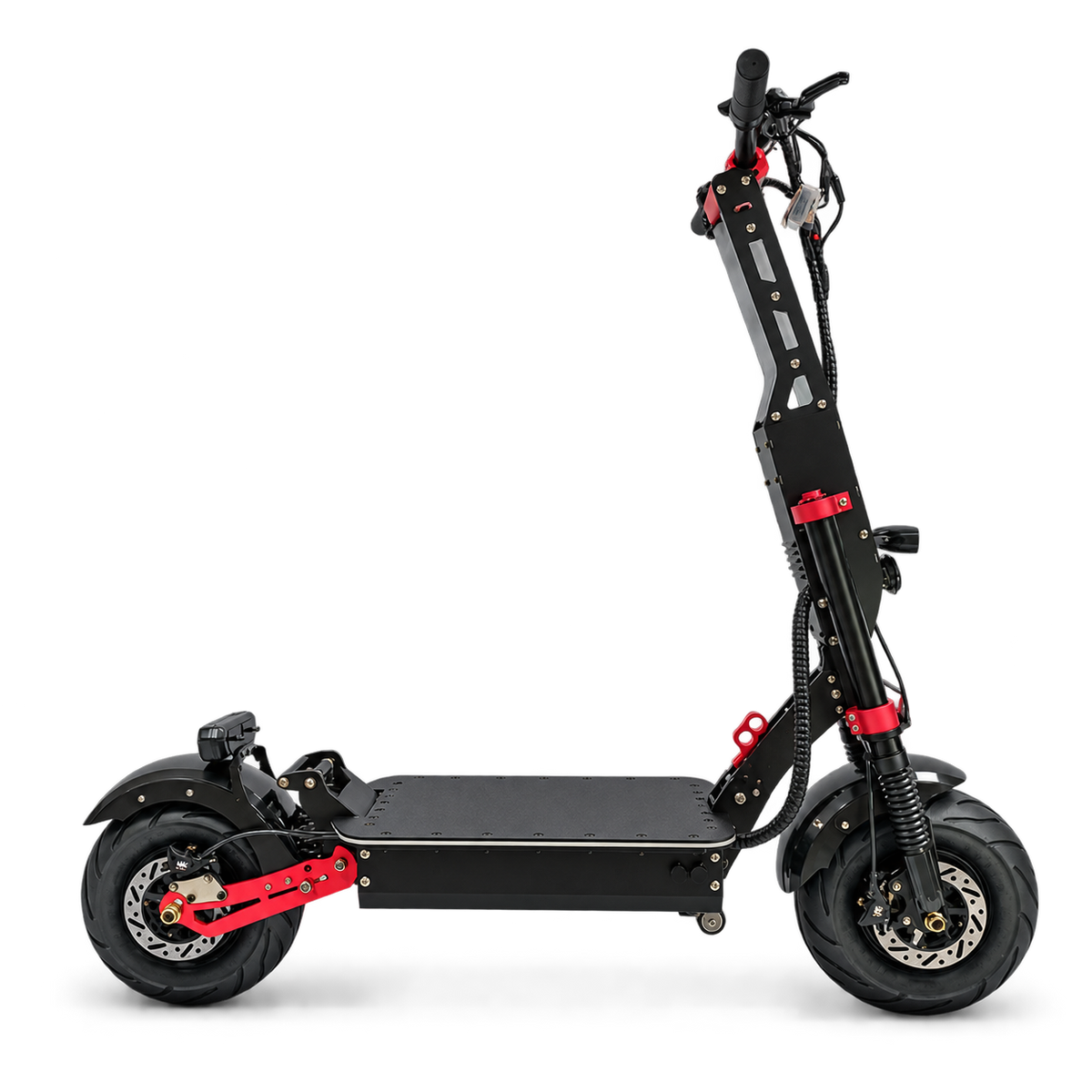
The R8 is described as a large-format scooter. If storage or lifting determines your purchase, request the dimensions and complete weight for your chosen configuration rather than estimating them from its photo. The cover image shows an R8 from our store library; it does not demonstrate a carrying test or establish suitability for your route.
5. Compare two everyday situations
A short ride followed by stairs: verify weight, handling and storage first. Even a short riding distance leaves the same staircase at the end of the day. If these details are missing, the model is not yet a confirmed fit.
A longer ride with ground-level storage: prioritize documented range for the selected version and the route conditions, then check the entrance and parking footprint. Ground-level access removes one carrying question but does not answer every storage question.
Neither situation identifies a universal best scooter. They show how to rank the information you need before comparing the Yisuntrek scooter lineup.
6. Compare the complete offer before paying
Once a scooter meets your route requirements, compare what each offer actually includes. The FTC's online shopping guide recommends checking the total cost, including delivery and other charges. This is a useful shopping principle; the checklist below does not state which taxes or fees apply to your location.
| Item | Record before payment |
|---|---|
| Exact vehicle | Model, voltage, battery capacity and tire selection |
| Included equipment | Charger and accessories included in this offer, separately from optional extras |
| Complete price | Currency, vehicle price, delivery, applicable charges and any items still unquoted |
| Delivery information | Destination covered, stated dispatch timing and transit estimate as separate entries |
| Support terms | Written warranty and return terms applicable to the purchase, with unclear wording resolved |
| Evidence record | Dated offer, configuration details and seller answers to essential questions |
A price example: compare the same package
Imagine two hypothetical offers in the same currency. Offer A lists a scooter at $1,800 plus $200 delivery. Offer B lists it at $1,950 with delivery included. Before any other charges, A totals $2,000 and B totals $1,950. The lower headline vehicle price is therefore not the lower subtotal in this example.
This is arithmetic, not a Yisuntrek quote. It is only a useful comparison if both offers cover the same configuration and equipment. If taxes, delivery-area surcharges or required accessories remain unknown, mark the total as incomplete rather than filling the gap with zero.
Keep essential questions separate from preferences
Use three simple statuses: confirmed, unanswered and does not meet my need. A confirmed color preference should not outweigh an unanswered essential carrying or range requirement. For example, if your staircase makes complete vehicle weight essential and the seller has not supplied it, leave that candidate unresolved even if its quoted price is attractive.
Save the final selection and the dated answer that resolved each essential question. For an R8-specific example of the configuration fields, see our R8 buying FAQ. A clear record also helps you identify the correct version when asking about parts later.
Your final shortlist
- Write the exact model and configuration beside each candidate.
- Confirm every essential requirement with current product information or a specific answer from the seller.
- Keep unknown measurements and test conditions visibly marked as unknown.
- Compare preferred features only after the essential requirements are resolved.
A useful pre-purchase message is: “My route is ___ km between charges, with ___ stairs and a storage space measuring ___. I am considering ___. Can you confirm the complete weight, folded dimensions and relevant range-test conditions for this configuration?”
Updated October 20, 2026.