
Electric scooter battery specifications often place volts, amp-hours and watt-hours side by side. They describe different things. Reading them together helps you compare battery options without confusing stored energy with motor power or a promised riding distance.
V, Ah and Wh: the quick explanation
| Unit | Meaning | What to check |
|---|---|---|
| V — volts | Electrical voltage. Nominal voltage is a reference value for the battery. | Whether the figure is nominal voltage or a charging voltage |
| Ah — amp-hours | Charge capacity under specified test conditions | The voltage accompanying the Ah figure |
| Wh — watt-hours | Energy capacity under specified test conditions | The manufacturer's stated energy rating for the exact pack |
The MIT Electric Vehicle Team's battery specification guide distinguishes nominal voltage, charge capacity and energy capacity. It also explains that actual terminal voltage varies with charge state and current. A voltage reading during use is therefore not the same type of number as a nominal rating on a specification sheet.
How to calculate watt-hours
For a nominal comparison, use Wh ≈ nominal V × Ah. The FAA's battery-rating explanation gives the volts-times-amp-hours calculation and explains that mAh must first be divided by 1,000 to obtain Ah. We cite that page for the unit calculation, not for transport eligibility.
Use the manufacturer's stated Wh rating when available. If you calculate a value from rounded catalog figures, label it as calculated rather than presenting it as a measured result.
| Example | Nominal voltage | Charge capacity | Calculated energy |
|---|---|---|---|
| A | 36 V | 20 Ah | 720 Wh |
| B | 48 V | 15 Ah | 720 Wh |
| C | 48 V | 20 Ah | 960 Wh |
Example A has more amp-hours than B, yet both calculate to 720 Wh. Example C has the same amp-hour figure as A but a higher calculated energy value. That is why an Ah-only comparison can be misleading when the voltages differ.
Why watts and watt-hours are different
Watts (W) describe power, while watt-hours (Wh) describe energy. In a simplified calculation, a constant 500 W electrical draw for one hour uses 500 Wh. This arithmetic does not predict scooter runtime: a motor's advertised wattage does not establish a constant battery draw throughout a ride.
Keep separate columns for battery Wh and motor W when comparing listings. Do not treat a larger peak motor-power number as evidence of a larger battery, or infer a guaranteed riding time by dividing battery energy by peak motor power.
Read the exact scooter configuration
The Yisuntrek Giant Monster R8 product page lists 30 Ah and 40 Ah options for its 60 V version, while the 72 V lineup includes additional 80 Ah and 100 Ah options. Check the selected combination rather than taking the largest figure from each part of the listing. The page also states that the 72 V 80 Ah and 100 Ah versions share the same listed motor configuration: choosing a different battery capacity does not automatically change the motor specification.
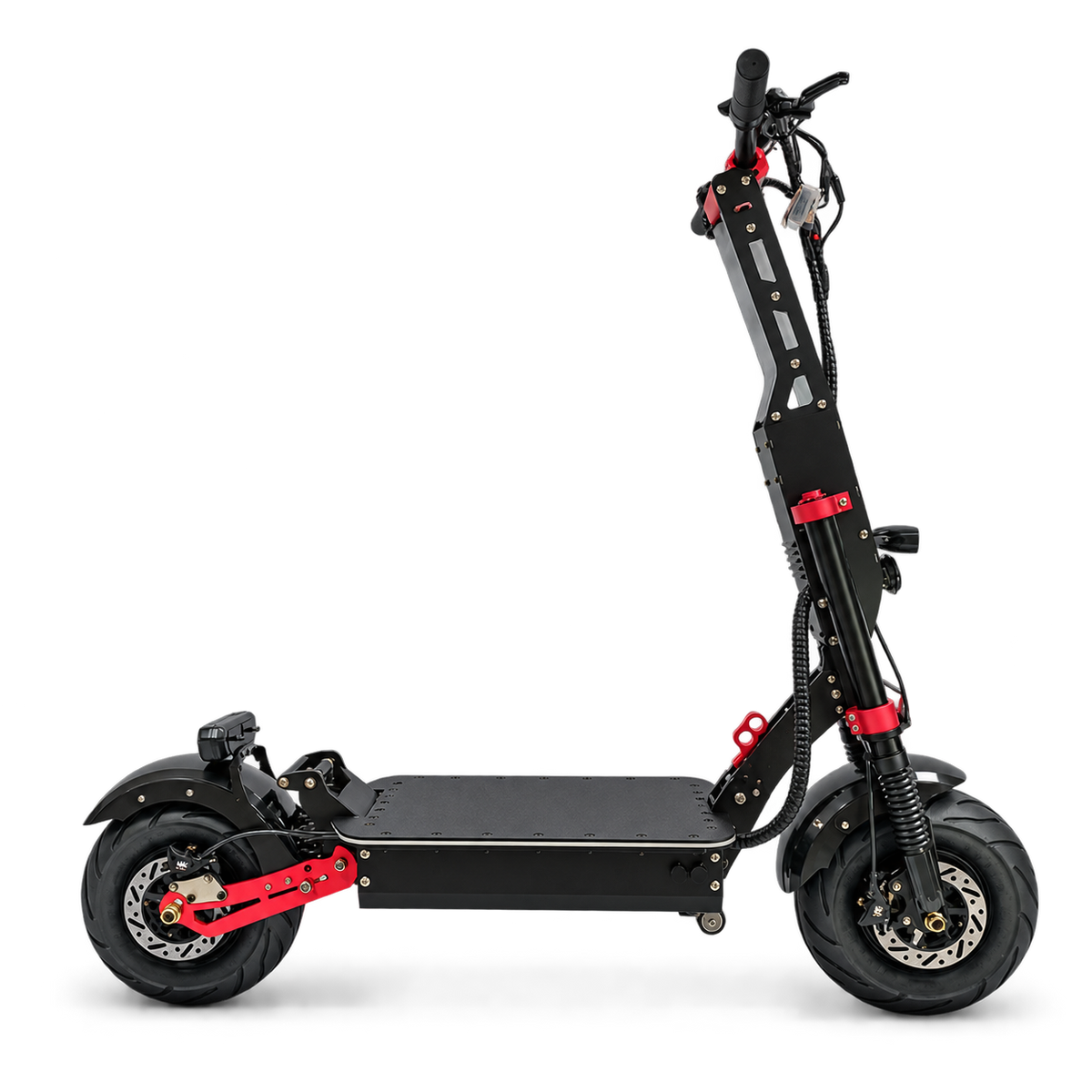
The cover shows an R8 from the store's image library. Its appearance does not identify the installed battery capacity; confirm that detail in the selected configuration and product documentation.
What these numbers cannot tell you by themselves
A Wh rating is not a distance in kilometres or miles. To evaluate a route, you still need range evidence for the selected scooter under relevant conditions. Our electric scooter range guide explains how to compare the test conditions behind a range claim.
Likewise, a high Ah or Wh figure alone does not document battery quality, warranty coverage or compatibility. Ask for the relevant product information instead of using one capacity number as a substitute for those answers.
A five-field comparison sheet
For each candidate, write down:
- The exact scooter model and battery option.
- The battery's nominal voltage.
- Its rated Ah capacity.
- Its stated Wh rating, or a clearly labelled nominal calculation.
- The source of those figures and any unanswered questions.
If the figures do not agree, ask the seller to clarify the label and configuration before deciding. A useful question is: “For this exact version, can you confirm the nominal V, rated Ah and stated Wh, and explain whether the catalog values are rounded?”
Use that sheet alongside our route-based scooter buying checklist. The goal is a comparison of documented configurations that fit your needs, not a search for the largest isolated number.